
Table of Contents
If you want to grow a blog in 2025, nothing is more important than mastering Long-Tail Keyword Research for Beginners. Today’s Google search environment has become more competitive, more AI-driven, and more focused on user intent—but the good news is that long-tail keywords still offer the fastest and easiest way for new bloggers to rank.
Long-tail keywords are longer, more specific search phrases people use when they want a clear answer, solution, or product. Since fewer websites target these terms, beginners have a much higher chance of ranking quickly. This is why Long-Tail Keyword Research for Beginners continues to be the most effective strategy for new bloggers and small websites in 2025.
Whether your blog is brand new or you’re trying to grow your existing content, mastering long-tail keywords will help you get traffic, earn authority, and create content Google wants to rank. This guide will show you exactly how to use long-tail keywords step-by-step, using a simple 7-step method designed for keyword research for beginners.
⭐ Why Long-Tail Keyword Research for Beginners Matters Most in 2025
Long-tail keyword research for beginners matters more than ever in 2025 because Google’s AI systems now focus heavily on intent, clarity, and topic depth—not just keyword volume. Short, broad keywords are dominated by high-authority websites, making it almost impossible for new bloggers to compete. But long-tail keywords open the door to fast rankings because they match specific user questions, have lower competition, and allow beginners to create more helpful, targeted content. When you understand how to connect long-tail keywords with search intent, you start ranking faster, driving better-quality traffic, and building authority even with a new blog. That’s why mastering Long-Tail Keyword Research for Beginners is one of the smartest SEO strategies in 2025.
Search patterns are changing. With Google SGE, AI Overviews, and smarter ranking systems, Google now evaluates:
✔ Search intent
✔ Content depth
✔ Relevance
✔ Context
✔ User satisfaction
This shift has made broad keywords harder to rank for, especially for new sites. But long-tail keywords remain a major opportunity because:
- They have lower competition
- They capture specific search intent
- They convert better
- They are easier to rank
- They attract the right audience
As a result, long-tail keyword research 2025 has become the foundation of modern SEO strategy.
Google loves precise, helpful answers. Long-tail keywords help you deliver exactly that.
Google’s AI search is changing everything, and learning how to rank in SGE is now essential for modern bloggers. SGE prefers structured, helpful, human-first content—especially when it answers user questions clearly. To understand which strategies actually work for SGE visibility, you can read our updated ranking guide here.

⭐ What Are Long-Tail Keywords? (Simple Explanation)
Long-tail keywords are longer search phrases, usually 3–6 words, that describe exactly what the user wants.
Examples:
❌ “SEO tools” (very hard to rank)
✔ “free SEO tools for starting blogging” (easy to rank)
❌ “blog ideas”
✔ “low competition blog ideas for students.”
These long descriptive keywords help Google understand your content clearly—and help your blog stand out.
This is why Long-Tail Keyword Research for Beginners works even for brand-new blogs with zero authority.
⭐ The Power of Search Intent in Long-Tail Research
If you want to do successful keyword research, you must understand long-tail & search intent keywords. Search intent means why the user is searching.
Four main types:
- Informational – “How to find long-tail keyword ideas.”
- Navigational – “YouTube Studio logi.n”
- Commercial – “best AI SEO tools 2025.”
- Transactional – “Buy a domain cheaply in India.”
Long-tail keywords almost always match one clear intent—this is why Google ranks them easily.
When writing content, your job is to match that intent perfectly.
⭐ 7-Step Long-Tail Keyword Research Method (Beginner Friendly)
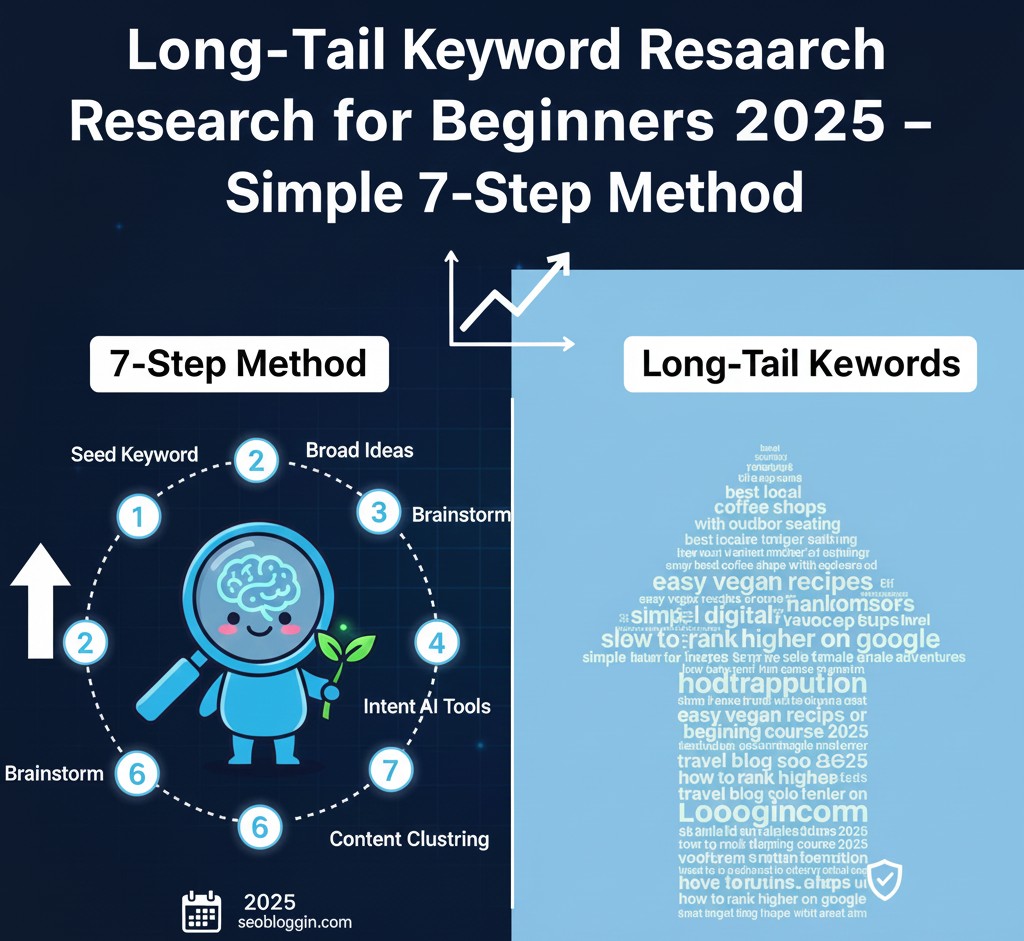
A simple, beginner-friendly long-tail keyword research method begins with selecting a niche topic you understand. Step 1: Start with a broad seed keyword. Step 2: Use tools like Google Autocomplete, AnswerThePublic, or free keyword tools to extract suggestions. Step 3: Identify question-based phrases because they show strong search intent. Step 4: Compare difficulty and competition using free SEO tools. Step 5: Group related keywords into clusters to build strong topic relevance. Step 6: Choose low competition long-tail keywords that match your content goals. Step 7: Create articles that directly answer user intent with clarity and depth. This structured approach ensures your content aligns perfectly with search demand and ranks higher, even with a new website.
This method is designed specifically for Long-Tail Keyword Research for Beginners, keeping things simple, powerful, and effective.
Step 1: Start With a Broad Topic
Begin with a simple topic relevant to your blog.
For example:
- Blogging
- Fitness
- Cooking
- AI tools
- Finance
- Education
- Technology
These broad topics help you generate an initial list of ideas. This step is essential in keyword research for beginners.
Step 2: Use Google Auto-Suggest (Free & Powerful)
Type your main topic into Google and notice the suggestions:
📌 Example: “blogging tips for…”
Google will show:
- blogging tips for beginners
- blogging tips for students
- blogging tips for low competition niches
Each of these is a low competition long-tail keyword.
Google suggestions come from real user searches—so they are extremely valuable.
Step 3: Explore the ‘People Also Ask’ Box
Google’s “People Also Ask” box is an unlimited goldmine of ideas.
Search:
“long-tail keyword research 2025”
You will find questions like:
- Find long-tail keywords?
- How do beginners do keyword research?
- Why are long-tail keywords important in 2025?
Each question can become an article topic.
This is one of the simplest easy keyword research method steps for beginners.
Step 4: Use Competitor Websites to Steal Easy Keywords
Check small websites in your niche—not big authority sites.
Search:
“site:yourcompetitor.com keyword”
Find their article structure, headings, FAQs, and topics.
Look for:
✔ keywords they didn’t cover
✔ weak content gaps
✔ outdated information
✔ missing long-tail variations
These turn into low competition long-tail keywords instantly.
If your impressions are stuck at zero, learning how to rank Web Stories is the fastest way to increase visibility and appear in Google Discover. Most creators miss simple optimization techniques—like keyword placement, image quality, and story sequencing. To understand the exact methods that boost Web Stories ranking in 2025, you can check out this step-by-step guide here.

Bloggers in 2025 are using an AI SEO blog writer to save time, research faster, and maintain a consistent posting schedule. But not all tools produce search-friendly content. If you want a detailed list of the best AI writers for SEO-packed blogging, explore our expert-tested recommendations here.
Step 5: Use AI Tools to Expand Keywords
AI tools like Google Gemini and ChatGPT can generate long-tail keyword ideas based on your niche.
Example prompt:
“Give me 30 long-tail & search intent keywords for beginners in the blogging niche.”
This will instantly give you:
- long-tail keyword ideas
- user intent phrases
- question-based keywords
- actionable content ideas
AI makes Long-Tail Keyword Research for Beginners 10× faster and 10× easier.
Step 6: Validate Keywords Before Using Them
Not every keyword is worth targeting.
Check three things:
✔ 1. Search Intent Accuracy
Does the keyword match your article idea?
✔ 2. Competition Level
Lower competition = faster ranking.
✔ 3. Monetization
Does the keyword bring a profitable audience?
These filters ensure you pick the right long-tail keyword research 2025 topics.
Step 7: Build Topic Clusters (Most Important)
To rank in 2025, you need topical authority.
Pick one main keyword and build supporting articles around it.
Example cluster:
🔵 Main Keyword: Long-Tail Keyword Research for Beginners
- how to find long-tail keywords
- easy keyword research method
- long-tail & search intent keywords explained
- low competition long-tail keywords for small blogs
Clusters help Google understand your expertise—and boost rankings faster.
⭐ Why Long-Tail Keyword Research Is Perfect for Beginners
Long-tail keyword research is ideal for beginners because it removes the pressure of competing with huge authority websites. Instead of targeting broad, competitive terms, beginners can focus on low competition long-tail keywords that match what real users search daily. These keywords have clearer intent, easier ranking potential, and often lead to higher click-through rates because they answer specific problems. For anyone starting SEO in 2025, using long-tail keyword research techniques is the smartest strategy — you get faster visibility, more targeted readers, and stronger chances of ranking multiple pages without needing high domain authority. This approach is not only simple but also the most reliable foundation for long-term blogging success.
Here’s why beginners must focus on long-tail keywords in 2025:
✔ Faster rankings for new blogs
✔ Lower competition than broad keywords
✔ Higher click-through rates
✔ More targeted traffic
✔ Higher earnings per visitor
✔ Easier content planning
If you are serious about growing your blog, Long-Tail Keyword Research for Beginners should be your No.1 priority.
If you want to discover smarter content ideas with less effort, learning how to use Gemini keywords effectively can transform your SEO workflow. Gemini helps you uncover hidden long-tail topics and user-intent phrases that traditional tools often miss. For a deeper breakdown on how Gemini can speed up keyword research and help you pick high-ranking topics, you can explore our complete guide here.

After the Rank Math Update November 2025, Google-focused optimization has become easier—but only if you know how to configure the new features correctly. Many bloggers are still missing important ranking boosts simply because they aren’t using the update’s AI recommendations. If you want to understand every update and apply the best settings for faster ranking, you can check out our complete tutorial here.
⭐ How to Find Long-Tail Keywords Easily (Beginner Hacks)
Finding long-tail keywords doesn’t have to feel complicated—especially when you follow a few simple beginner-friendly hacks that work in 2025. Start by typing your main topic into Google and checking the People Also Ask section, because it reveals real user questions that have low competition and high ranking chances. Next, use AI tools like Gemini or ChatGPT to generate dozens of long-tail & search intent keywords based on your niche—this gives you keyword variations you might never discover manually. You can also check autocomplete suggestions, related searches, and trending queries to identify low competition long-tail keywords that new websites can rank for easily. When you combine these methods, long-tail keyword research for beginners becomes simple, fast, and highly accurate.
Here are simple tricks anyone can use:
✔ Use question-based keywords
Because they convert extremely well.
✔ Check Reddit discussions
People ask real problems → perfect keyword ideas.
✔ Look at YouTube comments
Users share exact pain points.
✔ Use Pinterest search
Especially if you write about lifestyle, fitness, beauty, food, or home niches.
✔ Use Google Trends
To find trending long-tail keywords in seconds.
These methods are powerful additions to your easy keyword research method.
⭐ Example List of Low Competition Long-Tail Keywords
Low-competition long-tail keywords usually come from niche-specific questions, problem-solving phrases, or beginner-level topics that big websites rarely cover. For example, instead of targeting a general term like “blogging tips,” switch to highly specific phrases such as “blogging tips for beginners in 2025,” “how to do keyword research without paid tools,” or “best long-tail keywords for new blogs.”
These keywords attract smaller but far more targeted traffic—people who are ready to read, learn, and convert. When you build your content strategy around 0 competition or low-competition long-tail keywords, ranking becomes 10x easier, even for new websites. Add these keywords naturally into headings, intro paragraphs, and FAQs to increase relevance and visibility.
Here are some easy ideas you can target:
- how to start a blog with low investment 2025
- AI tools for keyword research beginners
- low competition niche ideas for students
- easy fitness routines for beginners
- best self-care habits for busy people
These long-tail keywords are almost guaranteed to bring traffic.
⭐ Common Mistakes Beginners Must Avoid
Avoid these mistakes if you want success:
❌ Choosing broad keywords
❌ Ignoring user intent
❌ Copying competitor keywords blindly
❌ Over-optimizing headings
❌ Not using long-tail & search intent keywords
❌ Not building topic clusters
❌ Writing articles without keyword mapping
Following this guide helps avoid all these mistakes.
⭐ Conclusion
Mastering Long-Tail Keyword Research for Beginners is the smartest way to grow your blog in 2025. Long-tail keywords allow you to rank faster, drive highly targeted traffic, and build authority—even if your website is new.
By using the simple 7-step method, beginners can find:
✔ low competition long-tail keywords
✔ accurate search intent phrases
✔ profitable content ideas
✔ long-tail keyword research 2025 opportunities
✔ easy keyword research method techniques
If you stay consistent and keep creating helpful content, you will see major improvements in ranking, traffic, and earnings.
FAQ’s
Q1. What is the easiest way for beginners to start keyword research in 2025?
ANS- The easiest method for beginners is to focus on long-tail keywords using simple AI-assisted tools. These keywords have clear intent, lower competition, and faster ranking potential. With just a few prompts and basic filtering, beginners can build a list of keywords that match their niche and are easy to write content around.
Q2. How can AI tools help me find low-competition keywords faster?
ANS- AI tools scan search patterns, related queries, and user intent instantly—saving hours of manual research. They highlight keyword difficulty, trending opportunities, and unexplored areas within your niche. This makes it easier to find keywords your competitors have overlooked.
Q3. Are long-tail keywords still effective in 2025?
ANS- Yes, long-tail keywords are more effective than ever because Google’s AI systems now prioritize intent and specificity. Long-tail phrases match precise user needs, making it easier for new blogs to rank faster with less competition.
Q4. How many keywords should I target in one article?
ANS- Ideally, one primary keyword and 3–5 LSI keywords. This keeps your article focused while giving Google enough context to understand your topic deeply. Avoid stuffing—use keywords naturally within headings, intros, CTAs, and conclusions.
Q5. How do I know if a keyword can rank fast on Google?
ANS- Quick-ranking keywords usually have: low competition, narrow user intent, smaller websites already ranking, and a clear topic structure. If the top results come from newer blogs or general sites, it’s a strong sign the keyword is easy to rank for.